Your First Off-Broadway Show
What to Expect (and Why It's Not Just "Cheaper Broadway")

Let's get something out of the way right now: Off-Broadway is not the minor leagues.
If you've been thinking of it as "Broadway's little sister" or, worse, as the place you go when you can't get Hamilton tickets, I understand the impulse. But you're wrong, and I say that with love. Off-Broadway is its own animal entirely, and once you've experienced it, you may find yourself wondering why you ever fought the Times Square crowds in the first place.
I've been writing for the stage for years, and some of the most electrifying nights I've had in a theater have been in rooms with fewer than 200 seats. This guide is for the curious, for people who love theater (or think they might) and are ready to step outside the big tourist productions and into something a little more alive.
So What Actually Is Off-Broadway?
Here's the boring-but-important technical answer: Off-Broadway refers to professional theater productions in New York City that perform in venues seating between 100 and 499 people. Broadway houses seat 500 or more and are clustered in Midtown Manhattan's Theater District. Below 100 seats, you're in Off-Off-Broadway territory, a wild and wonderful world of its own, but that's a story for another day.
That's the definition. But it tells you almost nothing about what the experience actually feels like.
What It Feels Like
Imagine walking into a Broadway theater. There's a grand lobby, a chandelier or two, ushers in matching vests, a merch table the size of a studio apartment. You climb stairs. You find your seat in a vast orchestra section. The stage is far away, framed by an ornate proscenium arch. You settle in. You are an audience member in a crowd of 1,500 people.
Now forget all of that.
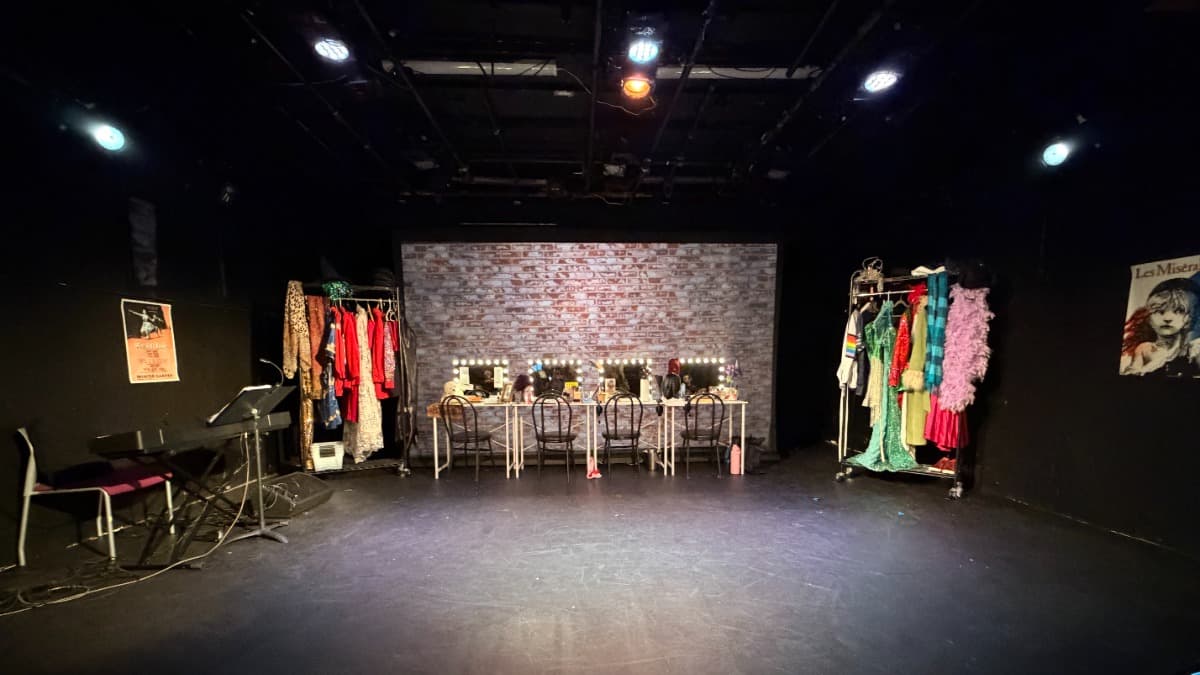
An Off-Broadway theater might be tucked into a converted church in the East Village. It might be a black box space in a basement on West 42nd Street. It might be a jewel-box theater in the West Village where the back row is still close enough to see the actors sweat. You walk in and the stage is right there. No binoculars needed. No craning your neck around a column.
Some beloved Off-Broadway venues (The Public Theater, Playwrights Horizons, the Lucille Lortel, the Minetta Lane, Atlantic Theater Company, New York Theatre Workshop) have been launching careers and landmark productions for decades. Others are scrappier, newer, and thrilling precisely because they don't yet have a reputation to protect.
The point is: proximity changes everything. When a performer's voice cracks with real emotion twelve feet from your face, when you can hear the breath before the line, when the lighting designer's choices wrap around you instead of washing over a cavern? That's a fundamentally different relationship between artist and audience. It's not lesser. It's closer.
The Shows Are Different, Too
Broadway, by economic necessity, tends to favor the sure thing. Jukebox musicals, movie adaptations, star vehicles, revivals of proven hits. The $10-to-$15 million price tag of mounting a Broadway musical demands a certain commercial logic.
Off-Broadway is where the American theater takes its risks. New playwrights get their shot. Experimental forms get tested. Stories that don't fit neatly into a two-act, intermission-included, tourist-friendly package find their home.
Some numbers to put this in perspective: it costs roughly $1 million to produce a musical Off-Broadway compared to nearly ten times that on Broadway. Weekly running costs for an Off-Broadway musical typically land somewhere in the $50,000 to $100,000 range, a fraction of a Broadway production's overhead. That leaner economic model is exactly what allows Off-Broadway producers and artistic directors to say yes to the weird stuff, the ambitious stuff, the stuff that might not sell 1,200 tickets a night but absolutely deserves to exist.
And here's the thing that shocks most first-timers: the quality is just as high. Many of the actors are Equity members with Broadway credits. The directors, designers, and stage managers are often the same professionals working on Broadway productions. You're not getting a discount on talent. You're getting a different kind of production, one that trades spectacle for intimacy and scale for precision.
The Pipeline Nobody Talks About
Here's a fun secret: many of your favorite Broadway shows started life Off-Broadway.
Hamilton premiered at The Public Theater. Fun Home did too. Little Shop of Horrors has been an Off-Broadway staple for decades. Titanique, the Céline Dion-powered Titanic parody that opened on Broadway this spring, built its cult following Off-Broadway. Cats: The Jellicle Ball, the drag-and-ball-culture reimagining of Andrew Lloyd Webber's classic, ran Off-Broadway before transferring uptown.
Off-Broadway is where the American theater develops its next generation of stories. Catching a show during its Off-Broadway run is like reading a novel in galley proofs. You're seeing the work in its most raw and immediate form, before the machinery of a Broadway production smooths everything out. Sometimes that rawness is the whole point.
Okay, But What About Tickets?
Yes, they're generally cheaper. You can often find Off-Broadway tickets in the $40 to $80 range, with rush tickets and digital lotteries bringing prices even lower. Some shows offer $30 student rush. NYC Tourism even runs an Off-Broadway Week twice a year with two-for-one deals.
But "cheaper" is the wrong frame. A better word is accessible. Off-Broadway ticket prices reflect the economics of smaller venues and leaner productions, not a lesser product. You're not saving money by settling. You're spending wisely on something great.
What to Actually Expect on the Night
A few practical things for first-timers:
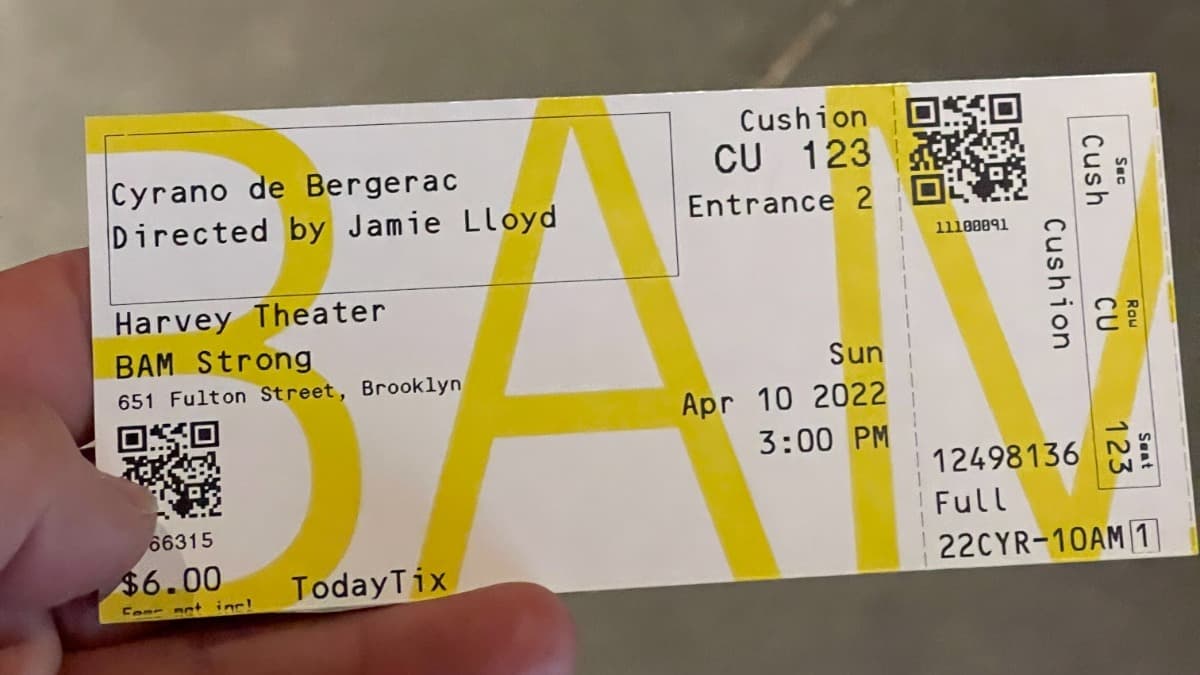
The venue might surprise you. Off-Broadway theaters are scattered across Manhattan (and sometimes Brooklyn). They're not concentrated in Times Square. Check the address before you leave the house. Your show might be at the Signature Center on West 42nd Street, or it might be at St. Ann's Warehouse under the Brooklyn Bridge. Both are wonderful. Neither is where you expect "theater" to be.
The lobby will probably be small. Don't expect a sprawling bar and lounge. Some Off-Broadway theaters barely have a lobby at all. The upside: you'll likely be close to the bar, if there is one, and the pre-show people-watching is fantastic because everyone is shoulder to shoulder.
There probably won't be an intermission. Many Off-Broadway shows run 90 minutes or less, straight through. This is a feature, not a bug. The compression creates an intensity that two-and-a-half-hour shows with bathroom breaks simply can't replicate.
Arrive on time. In a 150-seat theater, there's nowhere to hide when you walk in late. Latecomers are often held until a suitable pause in the action, and in some venues, you might not be seated at all.
The curtain call will feel personal. When the cast takes their bow in a small house, they can see you. They can see your face. Applaud generously. They earned it, and they'll notice.
Where to Start
If you're new to Off-Broadway and looking for your first show, here's my advice: don't overthink it. Pick something that sounds interesting: a playwright whose name you've heard, a subject that intrigues you, a theater company someone recommended. And then go. The beauty of Off-Broadway is that the financial risk is low and the artistic reward is almost always high.
Right now, spring 2026 is packed with options. There are new works by major playwrights, intimate musicals, returning hits, and star-driven productions featuring actors you'll recognize from both stage and screen. Check our listings for what's currently playing, and don't be afraid to take a chance on a show you've never heard of. That's the whole point.
Off-Broadway isn't a consolation prize. It's where the American theater is most alive, where stories are born, where risks get taken, where the distance between you and the art disappears.
Come sit in the dark with us. Twelve rows is all you'll need.
Photo Credit: Aaron Paulley, Sexual Misconduct of the Middle Classes

Aaron is a NYC playwright, lyricist, designer, producer, director & improv teacher who teaches adults with mental health conditions and writes about the theater he loves most. He has directed & produced in New York City and Long Island.
OffBroadwayGuide.com is your home for reviews, recommendations, and everything happening beyond the Great White Way.